
During the ICA’s recent ‘Parlour of the Year’ awards, one of the key judging criteria was, of course, the quality of the ice cream being served.
Many different factors will contribute to this, the cabinet, the flavours but, most importantly, the freshness.
Keeping your product fresh is, as you would expect, a must across the food industry; but in recent years it has become apparent that consumers are looking for freshness to be a cut above the rest. They want products made on site, the very morning of the day in which it was purchased. How fresh your product is, is a MASSIVE selling point.
Achieving a fresh product
There is a certain balancing act you need to adhere to, to ensure a fresh product and this is making sure that you have correct amount of stock to manage the expectations of the day ahead.
Too much stock and you could end up with a significant amount of waste. But not enough and you’ll have to declare a sell-out, leading to line of very disappointed customers outside your parlour.
So, our advice to customers when helping them produce a truly fresh product is to follow these three simple rules:
Rule one – preparing your mix
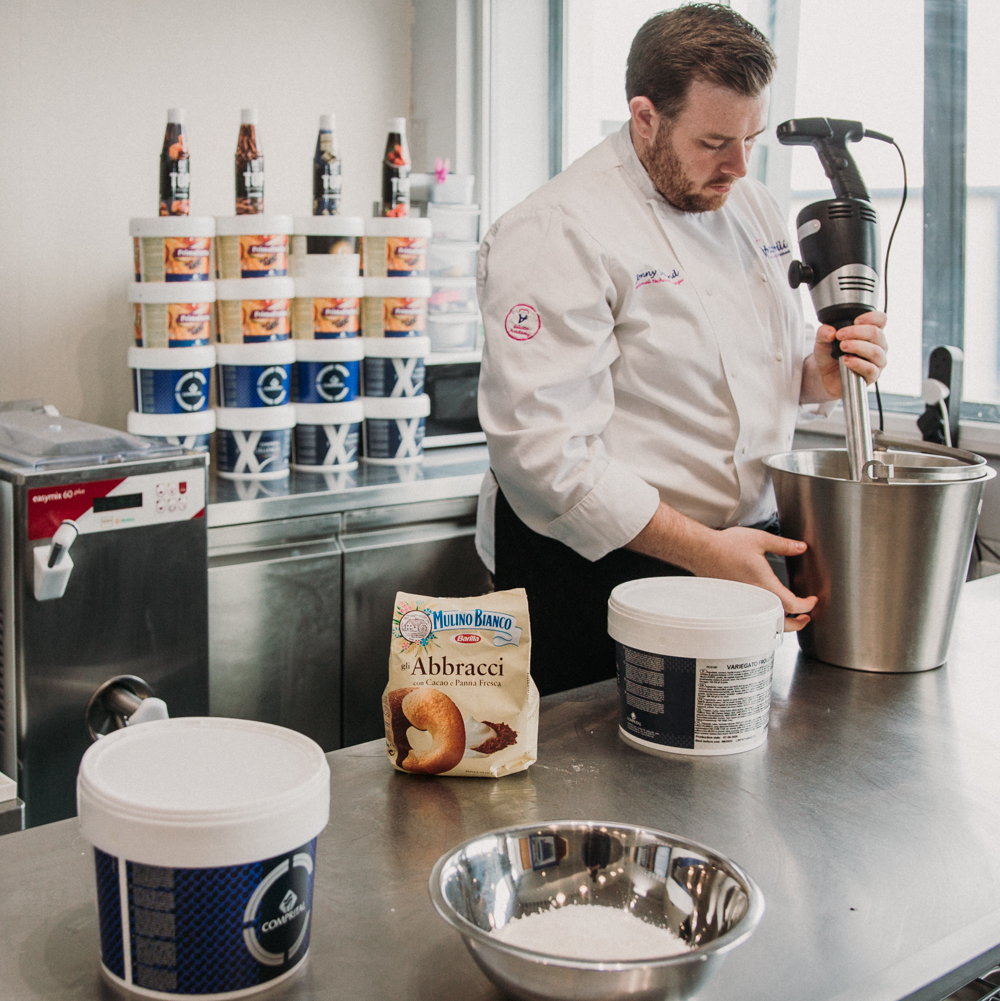
We know from previous articles that the best way to create a product with a long shelf-life is through pasteurisation. Pasteurising means that we have the ideal bind of fats and proteins; as it will take longer for these fats and proteins to separate, we ultimately get a longer shelf-life.
In addition to this, the use of emulsifiers and what we are now calling ‘hydro-solids’ will also play a role in improving shelf life. Hydro-solids such as sugar starches and vegetable fibres will absorb any loose water in your mix from milk or cream; this will slow down crystallisation.
Lastly, consider batch pasteurising 60 to 100 litres; this means that you can produce your gelato far more quickly each morning.
Rule two – freezing your mix
Once you have achieved perfect pasteurisation and have batch frozen your mix, it’s important to blast freeze your product; this will seal air inside the mix and help it to sustain a longer shelf-life. Blast freezing should be done for a minimum of 15 to 20 minutes to ensure it is solid on top, thereby trapping air and stopping crystallisation.
From your blast freezing stage you have two subsequent freezing stages to consider:
Stage one – Deep freezer
A deep freezer is typically set at around -21 to -22°c; what this does is freeze your product to a very solid temperature, and as long as it is lidded, you will extend its freshness.
It’s worth noting however that with this option, you don’t want to decorate at this stage as it will lead to discolouration and dullness of your product.
Stage two – Tempering freezer
From the deep freeze we then move onto the tempering freezer. This is typically set at around the same temperature as your display freezer to allow you to serve your product almost immediately once moved across; therefore, if your display freezer is set to -14°c then your tempering freezer must be set at -15°c.
When moving your product to these temperatures it will, of course, shorten the shelf life of your product BUT it will be ready to go straight into your cabinet to serve. Your product can be left in the tempering freezer for around 3 to 5 days.
It is during the moving of products between deep freeze and tempering that we can get that all-important decoration on your ice cream or gelato.
When moving from tempering to your display cabinet, you should consider how fresh your product needs to be. For example, if you want your ice cream to be smooth, soft, and spatula-able (a very technical term we know), then it’s important to keep decoration low when we extract from your batch freezer. This allows the product to stay below the air flow of the ventilated display cabinet, keeping the temperature of the ice cream consistent, meaning we can spatula and stretch the product onto a cone.
If decoration is high then we’ll need a firmer product that is more suited to being scooped, as this will cross the air flow in the cabinet and will ultimately go softer more quickly, reducing its shelf life.
Rule three – maintaining your mix
Once you’ve had a great day of serving your fresh ice cream to delighted customers, it’s time to maintain your product to ensure it is as fresh as possible for the following day.
Therefore, when you’re finished serving, remove your gelato or ice cream from your display cabinet and place it back into your tempering freezer.
By doing this, you can turn your display freezer off, thereby resting the compressor and ensuring that you put a stop to any melting and re-freezing of the product overnight.
So, there you have it, how to guarantee the freshest, sought-after product to your customers. By following these simple (yet significant!) steps, we can ensure the highest quality and freshest-feeling product, leading to potentially award-winning ice cream or gelato.